
Projects / Mira Ceti
Mira Ceti
miraceti.ai ↗What if you truly felt at home? An interior-architecture studio that rethinks apartments, with AI as backup.
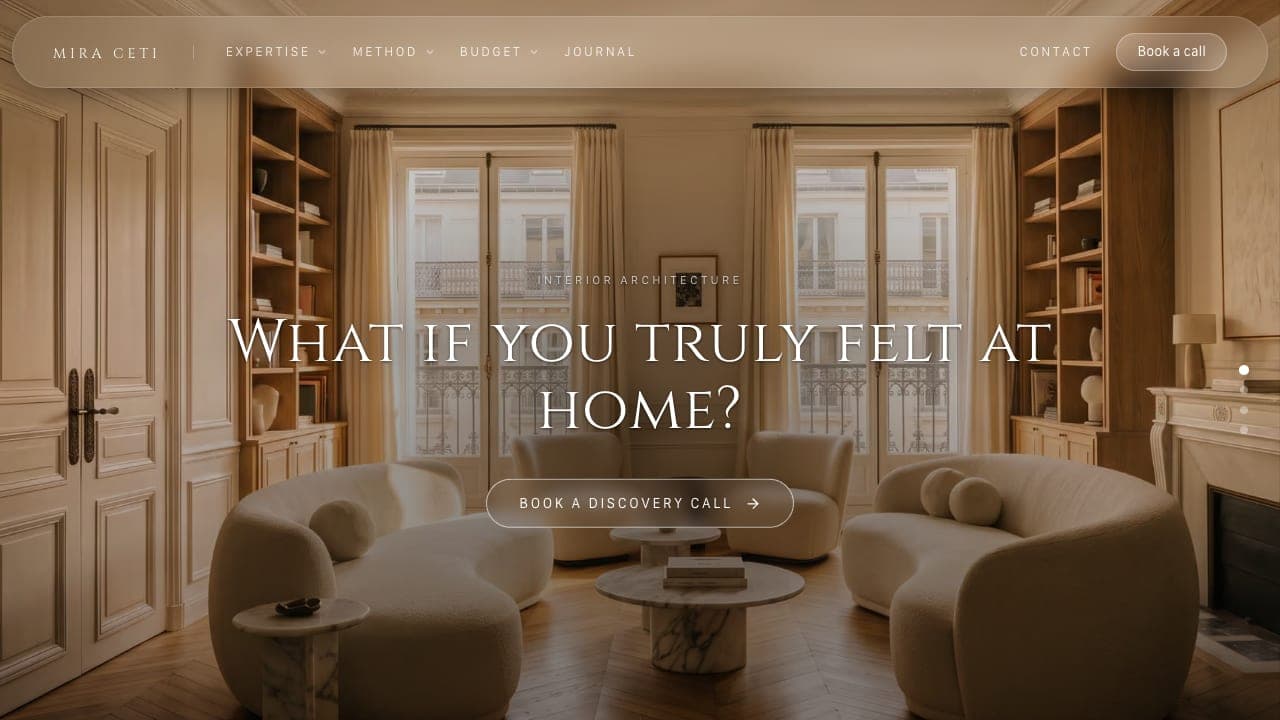
Mira Ceti is an interior-architecture studio I started with my best friend, a recognised interior architect and designer. We have known each other since childhood, worked together for years on very different projects, and even renovated apartments side by side. At some point the obvious became a plan: make it a real studio.
The principle is simple: rethink an apartment from the ground up — layout, volumes, light, custom furniture — and deliver a complete file, ready for the works. He is the interior architect; I am not. I bring the rest: the tools, the method, and the AI that lets us explore ten options where we used to draw one.
What AI changes, concretely: we test more variants in less time, and the client sees perspectives faithful to the materials and the light before deciding. The decision stays human; the options are no longer the bottleneck.
If you have an apartment that deserves better than its current plan, it starts with a discovery call on miraceti.ai.
Save months.
Products, marketing, tools: I test a lot, sum up what works, you avoid my mistakes.
An OpenClaw alternative is worth switching to only if it keeps the part you wanted, an agent that acts while you are asleep, and drops the part that should worry you, one always-on assistant holding every credential you own. Three shapes are on offer: another general assistant, a self-hosted workflow runner, or a narrow agent with a scheduled trigger and a single exit door.
Base44 and Lovable both turn a prompt into a working app on day one, so day one is not where the choice gets made. It gets made by who owns the backend: Base44 keeps your database and auth inside its own platform, while Lovable writes a React codebase you own and connects it to a Supabase project you control.
LinkedIn's Post Inspector, at linkedin.com/post-inspector, reads a URL the way LinkedIn's crawler does and clears the preview LinkedIn had stored for it, so your next share picks up the tags currently on the page. That is the whole job: it refreshes, it does not validate. When the preview is still wrong after you run it, the cache was never the problem. The image you shipped is.
Follow up on a cold email only when you can add one fact that did not exist when you sent the first one. Not a bump, not a polite reminder that you are still waiting: something the reader did not know before. Two follow-ups written that way beat six written in advance, because a sequence drafted before you send can only ever report that time has passed.