
Projects / ReadyToPost
ReadyToPost
readytopost.ai ↗Your AI community manager: it writes your posts, answers comments and DMs, tracks results. You approve, that's all.
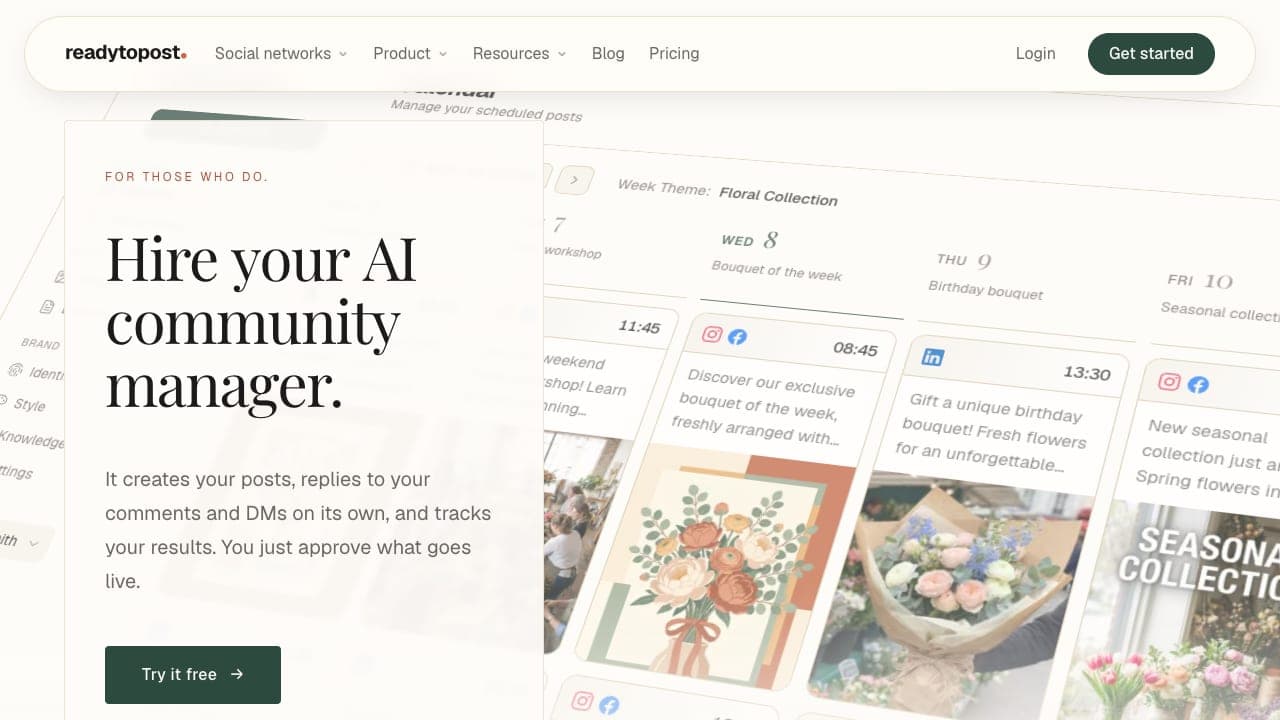
ReadyToPost exists because two childhood friends wanted to open an interior-architecture studio and had no idea how to make it known. We did what everyone does: we opened the social accounts and started posting. It wasn't our thing — too long, too time-consuming, and for far too little in return.
Every week, the same ritual: find an idea, write it three ways for three networks, make a visual, publish at the right time, then answer the comments and messages we never had time for. Two friends spending their evenings being a social media team, badly.
So I built the agent we needed. ReadyToPost learns a brand from its website, generates the posts — images and captions — publishes them to Instagram, LinkedIn, Facebook, Pinterest and X, replies to the comments and DMs that come back, and reports what worked. You approve what goes live; that's the whole job left.
If you run a small brand and social media eats your evenings the way it ate ours, that is exactly the problem ReadyToPost was built for.
Save months.
Products, marketing, tools: I test a lot, sum up what works, you avoid my mistakes.
An OpenClaw alternative is worth switching to only if it keeps the part you wanted, an agent that acts while you are asleep, and drops the part that should worry you, one always-on assistant holding every credential you own. Three shapes are on offer: another general assistant, a self-hosted workflow runner, or a narrow agent with a scheduled trigger and a single exit door.
Base44 and Lovable both turn a prompt into a working app on day one, so day one is not where the choice gets made. It gets made by who owns the backend: Base44 keeps your database and auth inside its own platform, while Lovable writes a React codebase you own and connects it to a Supabase project you control.
LinkedIn's Post Inspector, at linkedin.com/post-inspector, reads a URL the way LinkedIn's crawler does and clears the preview LinkedIn had stored for it, so your next share picks up the tags currently on the page. That is the whole job: it refreshes, it does not validate. When the preview is still wrong after you run it, the cache was never the problem. The image you shipped is.
Follow up on a cold email only when you can add one fact that did not exist when you sent the first one. Not a bump, not a polite reminder that you are still waiting: something the reader did not know before. Two follow-ups written that way beat six written in advance, because a sequence drafted before you send can only ever report that time has passed.